
Published: January 14, 2022 • Updated: December 23, 2025
Seeing hairline cracks in the slab can be alarming, especially when they appear in your home, garage, or basement. Many homeowners immediately worry about concrete damage or costly structural repairs.
Most hairline cracks in concrete slabs are normal and usually caused by shrinkage as the concrete cures. However, cracks that are wider than 1/8 inch may indicate an underlying structural issue.
Understanding what qualifies as a hairline crack, why it forms, and when it becomes a concern can help you decide whether to monitor it or call a professional.
What Is a Hairline Crack in a Concrete Slab?
A hairline crack in a concrete slab is a very thin surface crack, typically measuring less than 1/16 of an inch wide. These cracks often appear as faint lines and usually do not extend through the full thickness of the slab.

Hairline cracks commonly form in basement floors, garage slabs, patios, and walkways as concrete cures and adjusts to temperature and moisture changes. In most cases, they are cosmetic and do not affect the slab’s structural performance.
While most hairline cracks are cosmetic, professional concrete crack repair may be recommended if the concrete floor cracked, shifted, or spread beyond the slab surface, which signals a more serious issue.
Types of Hairline Concrete Cracks (Normal vs Concerning)
Not all hairline concrete cracks behave the same way. The key difference is whether the crack stays stable or changes over time.
- Shrinkage Hairline Cracks (Normal): Thin surface cracks that form as concrete dries and cures.
- Settlement Hairline Cracks (Monitor): Small cracks caused by minor soil movement beneath the slab.
- Temperature-Related Hairline Cracks (Normal): Fine cracks caused by expansion and contraction.
- Structural Cracks (Concerning): Cracks that widen, shift, or extend into walls or structural elements.

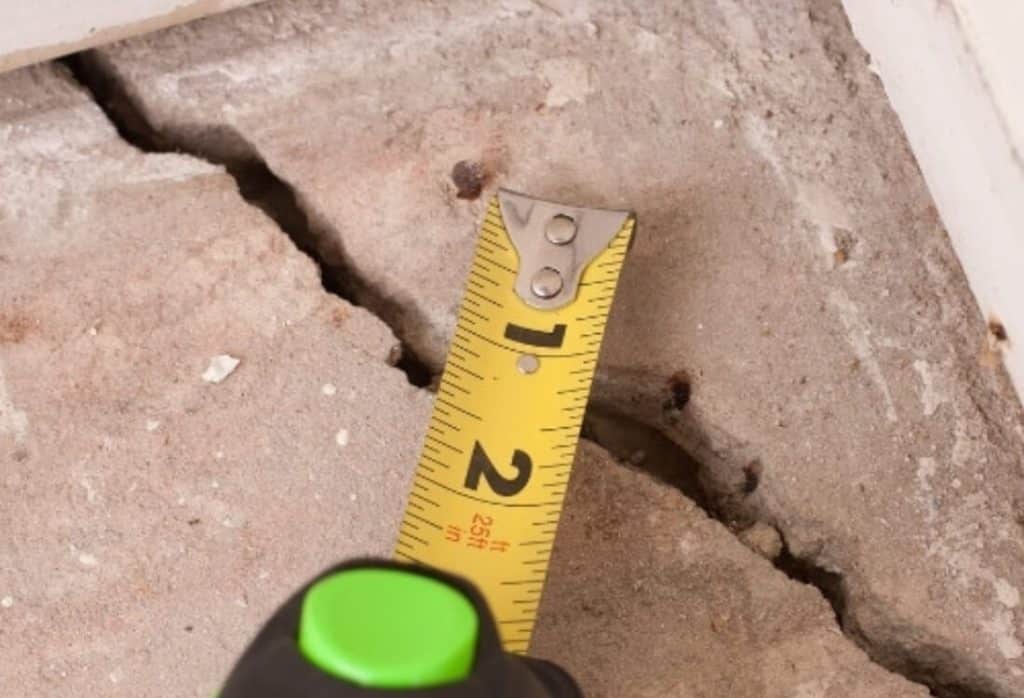
What Causes Hairline Cracks in Concrete Slab?
There are several main causes of concrete slab cracks. Some occur during construction, and others over time. The most common causes of cracks in a concrete slab after construction have been completed are:
- Expansion and temperature changes
Concrete naturally expands in heat and contracts in cold weather. These temperature shifts can create stress within the slab, leading to fine surface cracks. - Heaving from freeze-thaw cycles
In colder climates, soil moisture beneath the slab can freeze and expand, lifting the slab slightly. Repeated freeze-thaw cycles can result in cracking over time. - Excessive weight on the slab
Heavy loads, such as vehicles, equipment, or dumpsters, can exceed a slab’s design limits, leading to cracks. - Soil settling beneath the slab
As soil compacts or erodes beneath a slab, voids can form. Without consistent support, the slab may crack under its own weight.
Building codes also influence how concrete slabs are constructed. According to the 2021 Virginia Residential Code (R322.3.4), slab thickness, joint placement, and reinforcement standards are designed to manage normal cracking during curing and use.
Many of these causes result in cosmetic cracking, but changes over time may signal a larger issue.
When Are Hairline Cracks Normal — and When Should You Worry?
The difference between normal and concerning hairline cracks comes down to size, movement, and moisture.
| Crack Condition | Recommended Action | Why It Matters |
|---|---|---|
| Hairline cracks thinner than 1/16 inch | Monitor only | These cracks are usually cosmetic and often form during curing or normal slab movement. |
| Hairline cracks that stay the same size | Monitor over time | Stable cracks that do not widen or lengthen typically do not indicate structural problems. |
| Cracks in high-traffic or load-bearing areas (garages, walkways) | Monitor | Repeated weight loading can naturally cause harmless surface cracking over time. |
| Hairline cracks that allow no moisture through | Monitor | Dry, surface-only cracks rarely require repair. |
| Cracks that grow wider or longer | Consider repair or evaluation | Expanding cracks may indicate slab movement or stress below the surface. |
| Cracks with uneven, lifted, or sunken edges | Professional evaluation recommended | Vertical displacement can signal settling or soil-related issues. |
| Cracks that allow water intrusion | Repair advised | Moisture entering the slab can worsen cracking and lead to freeze-thaw damage. |
| Cracks extending into walls, door frames, or masonry | Professional evaluation recommended | These patterns may point to broader structural movement. |
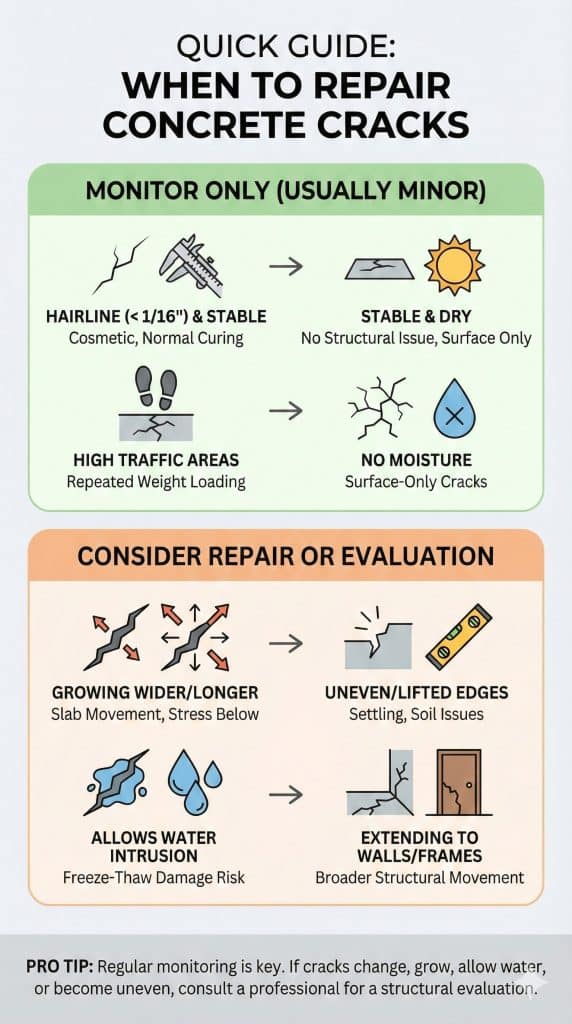
When to Call a Professional About Concrete Slab Cracks
You should contact a professional for concrete slab cracks if:
- A concrete hairline crack exceeds 1/8 inch in width.
- The slab becomes uneven or begins to lift or sink.
- Water enters through the crack.
- Cracks extend into walls, door frames, or foundation elements.
- Multiple cracks appear in a short period of time.
Even small cracks can indicate deeper issues if they change. In these cases, a professional concrete slab crack inspection can help determine whether the crack is cosmetic or due to settlement or soil movement.

Get a Professional Evaluation Before Hairline Concrete Cracks Worsen
If you’re noticing concrete hairline cracks and want clarity before they become a bigger issue, a professional inspection can help. LUX Foundation Solutions offers free, no-obligation assessments and estimates for concrete repair across Northern Virginia.
Our specialists will assess the crack, explain what’s happening, and advise whether repair is needed or simple monitoring is enough.
Contact us today at 540-508-8587 to schedule your free estimate and get peace of mind.
Commonly Asked Questions
Should minor hairline cracks in concrete be repaired?
In most cases, no. Monitoring is usually sufficient as long as the crack remains thin, stable, and dry. Cracks that change over time or appear alongside other structural symptoms should be evaluated more closely.
Are hairline cracks in a new concrete slab normal?
Yes, hairline cracks can form as concrete cures and dries. These are usually cosmetic unless they widen, spread, or show signs of moisture intrusion.
Is it normal for a concrete slab to crack?
Yes. It is normal for concrete slabs to develop small cracks over time. Concrete naturally shrinks as it cures and expands and contracts with temperature changes, which often results in minor cracking.
What are the acceptable cracks in a concrete slab?
An acceptable crack in a concrete slab is typically less than 1/8 inch wide, does not change over time, and does not cause uneven surfaces or water intrusion.
What does a hairline crack in concrete look like?
A hairline crack appears as a very thin, shallow line on the concrete surface, often similar to a pencil line or strand of hair. These cracks usually do not extend through the full depth of the slab.